

MPox background
The MPXV designation remains for the virus; the illness is now called MPox. Clustered outbreaks precipitate concern, and reviews are regularly re-packaged with minor incremental improvements in understanding. Essentially a pox virus that infected a number of tropical animals and is able to move to humans, who then infect each other, mainly by close physical contact.
Clinical features:
Fever, headache, malaise and myalgia are described in observational cohorts1 with the usual variation to be expected from reporting sites with different referral patterns and ease of access2. The key points concern the rash and lymphadenopathy. A person who has been in intimate physical contact with somebody with suggestive features and who now presents with inguinal adenopathy, a small number of relatively non-itchy vesicles or pustules all of the same age, and systemic symptoms of fever and headache should have the diagnosis seriously entertained. A child with vesicles and pustules of different ages all over the body and with no adenopathy has probably got chickenpox.
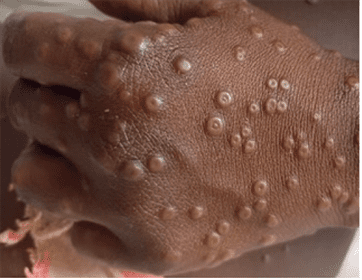
Signs and symptoms are usually self-limiting and resolve by themselves in 2 to 4 weeks.
| Feature | MPox | Chicken pox | Herpes zoster | Molluscum contagiosum |
|---|---|---|---|---|
| Fever and headache | Common | Common | Rare | Unusual |
| Rash distribution | Inguinal, centrifugal occasionally widespread | Generalised but can be sparse | Dermatomal (can be in an inguinal dermatome), occasionally disseminates | Localised but not dermatomal, can spread in scratches (Koebner phenomenon) |
| Cropping (not all lesions the same age) | Said to be unsual, but is described | Commonly cropping | Usually a single vintage | Spreading rather than disseminated cropping |
| Itch | Less marked | More marked | Rare | Rare |
| Adenopathy | 50 to 70% | Unusual unless secondarily infected | Rare | Very rare |
| Associated STI (gonococcus, H simplex, chlamydia) | About 30% in some series | Unlikely | Unlikely | Occasional |
Complications
These are clearly more common and more serious in immunocompromised individuals, and include pneumonia, bacterial infection of the skin, corneal injury with scarring, encephalitis and dehydration.
Management
This is usually supportive (fluids and analgesia). If patients require nursing in hospital (and the usual reason for this is rectal/inguinal pain and oedema) then be sure to initiate contact precautions (mask, face shield, gown, gloves although most infection is through direct contact and there is little evidence to support respiratory spread.
Silva SJRD, Kohl A, Pena L, Pardee K. Clinical and laboratory diagnosis of monkeypox (mpox): Current status and future directions. iScience. 2023 Jun 16;26(6):106759. doi: 10.1016/j.isci.2023.106759. Epub 2023 Apr 28. PMID: 37206155; PMCID: PMC10183700 ↩
Dou X, Li F, Ren Z, Zhang D, et al. Clinical, epidemiological, and virological features of Mpox in Beijing, China – May 31-June 21, 2023. Emerg Microbes Infect. 2023 Dec;12(2):2254407. doi: 10.1080/22221751.2023.2254407. PMID: 37649257; PMCID: PMC10494722. ↩